Hong Kong has one of the most active construction and interior design markets in Asia. New residential blocks go up in Tseung Kwan O and Lohas Park. Office fit-outs restart in Wan Chai every time a lease changes hands. Renovation projects run continuously across Kowloon City, Sai Kung, and the older housing estates of Kwun Tong and Sham Shui Po.
The contractors behind this work — the general contractors, the fit-out specialists, the ID firms doing residential renovations — are typically small operations. A principal, two or three project managers, a few foremen on site, and an admin person handling paperwork. Revenue runs from a few million to tens of millions of Hong Kong dollars a year, depending on the size of projects they pursue.
And almost every one of them runs their business relationships the same way: a mix of WhatsApp groups, email threads, a folder of PDF quotations, and a memory of which client said they were “definitely interested” three months ago.
That system works until it doesn’t.
Where the money is lost
Construction and interior design are project businesses. The business model is simple: win the job, deliver the job, get paid, win the next job. But the gap between “client expressed interest” and “signed contract” can be weeks or months — and in that gap, deals die quietly.
A client inquires about a bathroom renovation in Taikoo Shing. The principal visits the flat, measures up, and prepares a quotation. The quote goes out by email. The client says they’ll “think about it.” Three weeks pass. The client has received two other quotes and the lowest bidder has already called to follow up twice. The principal hasn’t followed up at all — not because they forgot the client existed, but because they had four active sites running and no system to remind them.
The job goes to the other contractor. Not because of price. Because of responsiveness.
This pattern repeats across the industry. The revenue is not going to better craftsmen — it is going to more organised businesses.
A second place the money leaks: existing clients who never come back. A client who renovated their Sheung Wan flat three years ago is now thinking about their parents’ place in Mei Foo. They liked the contractor’s work. But the contractor never followed up after handover, never checked in on the snag list resolution, never sent a message at Chinese New Year. The client can’t remember the name of the contractor and ends up searching online from scratch.
In a referral-driven business, this is expensive. A satisfied renovation client who becomes a referrer is worth more than five new cold enquiries.
Three businesses, three familiar problems
The fit-out contractor in Kwun Tong. Eight-person team specialising in commercial office fit-outs — open plan offices, meeting rooms, server rooms. Their clients are typically corporate tenants in Kowloon East, often introduced through property agents or facilities managers. Current process: enquiries come in by phone or email, the principal prepares a quotation, and if the job is won it goes into an Excel tracker shared on Google Drive. If the job is lost, the client information disappears — nobody knows whether the prospect took a competitor’s quote or simply didn’t proceed.
In the last financial year, the principal estimates they quoted on at least 15 jobs they could have won with better follow-up. He bases this on two callbacks he received from clients who said they went elsewhere but were unhappy — and wanted a second chance. He has no idea how many others quietly moved on.
The interior design firm in Sai Ying Pun. A husband-and-wife team with one junior designer, doing mid-to-high-end residential renovations — mostly 1,000 to 2,000 sq ft flats in the western part of Hong Kong Island. Their reputation is excellent. Work comes mainly through personal referrals. The problem: every project involves hundreds of decisions, client approvals, and follow-up messages. Site photos are shared through WhatsApp. Change order approvals happen in conversation. Payment milestones are tracked in a Notes app.
When a dispute arises — a client who claims they approved a different tile finish, a payment milestone that was never formally acknowledged — there is no clear record. The couple spent six weeks in an uncomfortable back-and-forth with a client who genuinely did not remember approving a substitution that was discussed verbally on a site visit. No email, no message log, no signed change order.
The general contractor in Yuen Long. Medium-sized operation — 15 people in the office, subcontractor teams on site. Handles a mix of government works contracts and private development small works. Their business development challenge is different: they are invited to tender on jobs rather than receiving inbound enquiries, but they still need to track which tenders are open, which have been submitted, which are under evaluation, and which existing clients they should be cultivating for future work.
Currently, all of this is in the head of the business development manager and a spreadsheet she updates manually. When she was on maternity leave last year, the principal missed two tender submission deadlines because he didn’t know they were coming.
What a CRM does for a construction or ID business
A CRM is not project management software. It does not replace your site foreman’s task list or the Gantt chart your project manager uses to schedule subcontractors. It handles the client relationship side of the business — from the first enquiry to the signed contract, through the project, and into the post-handover relationship.
A central record of every enquiry and client. Every potential client — whether they came through a property agent referral, a Google search, or a recommendation from a previous job — gets a record in the system from the moment of first contact. Name, phone number, location of the property, type of work they need, budget range if they’ve mentioned it, and a note on how they found you. When a prospect you spoke to four months ago calls back, any member of your team can pull up the history in 10 seconds.
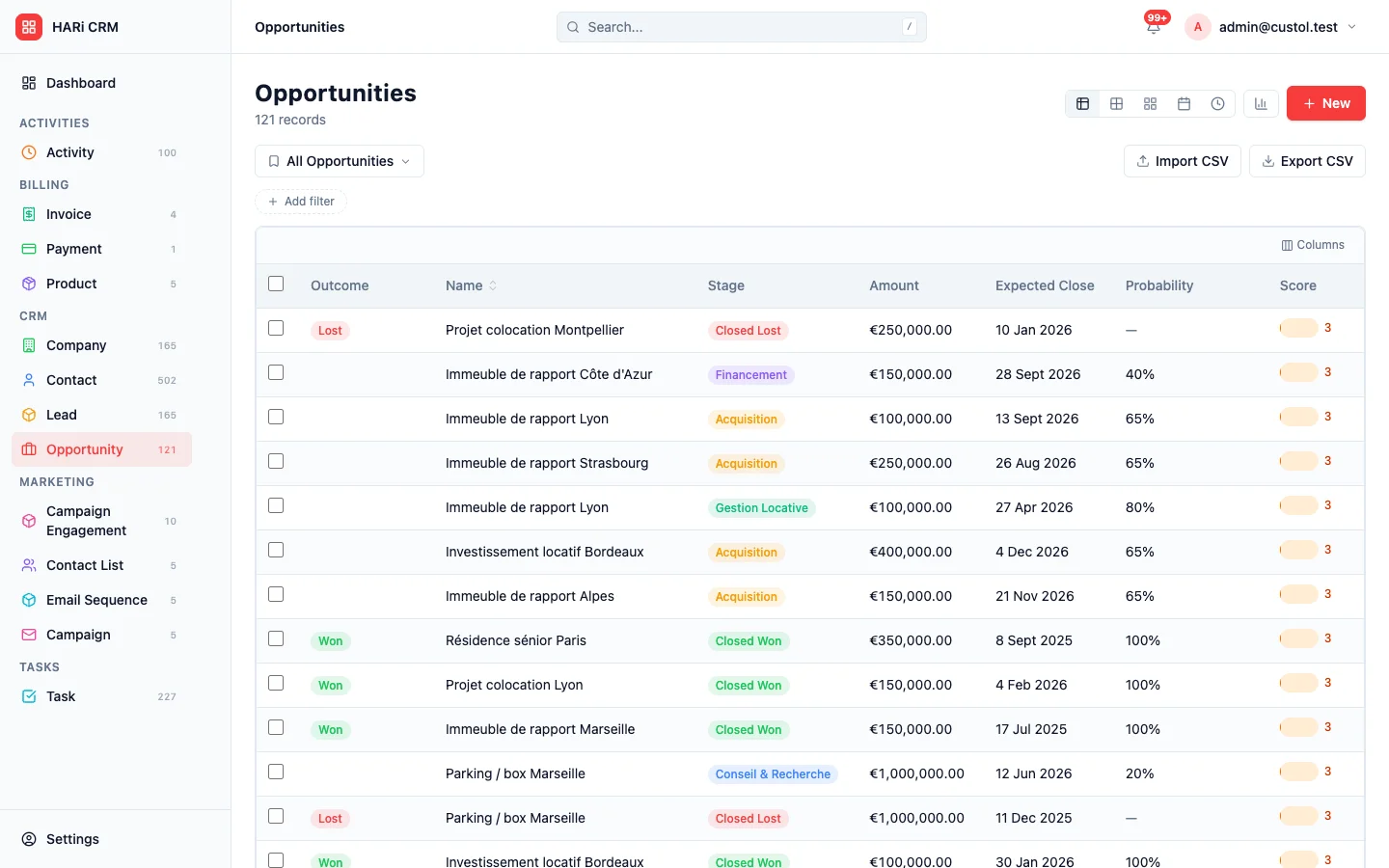
A quotation pipeline you can actually see. Instead of quotations living in individual email drafts, every quoted job is a record in your pipeline. You can see, at a glance: how many jobs you’ve quoted this month, how many are in discussion, how many have gone quiet, and how many are won or lost. A pipeline stage for “Quoted — awaiting response” with a follow-up reminder at 7 days and another at 21 days is the simplest intervention that changes win rates. Most contractors simply do not have this.
Activity logs for client communication. Key conversations — a WhatsApp message about a change order, an email confirming a payment milestone, a phone call where the client approved a material substitution — can be logged against the client record in a few seconds. Not every message, just the ones that matter. Over the course of a six-month renovation project, this log becomes your record of what was agreed, when, and by whom. In a dispute, it is worth far more than a memory.
Retainer and recurring client tracking. Some ID firms work with property developers who commission multiple units. Some fit-out contractors have a property management company that calls every time a tenant changes. These are recurring revenue relationships that deserve the same systematic attention as new business. A CRM lets you track the relationship status, the last interaction, and the next expected opportunity — so you stay visible between jobs rather than being remembered only when the phone rings.
Post-handover follow-ups that actually happen. Six weeks after completing a renovation, a short message asking whether everything is working well — whether the snagging issues were resolved, whether the client is happy with the outcome — is both good customer service and an implicit referral request. Almost no contractor in Hong Kong does this systematically. The ones who do are remembered. A CRM lets you schedule this follow-up at handover, so it happens regardless of how busy the site schedule is.
The approval and change order problem
In construction and interior design, the most common source of disputes is not workmanship — it is communication about changes. A client decides mid-project that they want a different flooring material. The contractor agrees verbally on site. No written record. At handover, the client’s spouse, who wasn’t at the site visit, expects to see what was in the original specification.
This is one of the most avoidable problems in the industry, and it comes down to documentation discipline.
A CRM provides the habit and the tooling. When a change is agreed, log it: what was discussed, what was agreed, when, and with whom. If you send a follow-up message confirming the change, log that too. Over time this becomes standard practice — not a burden, just how your team operates.
It also works the other direction. When a client contacts you after handover to raise a concern, you can look at the project record and see what was discussed at each key milestone. “We confirmed the tile substitution by WhatsApp on 14 February, and I can see your message confirming you were happy with the sample” is a very different conversation from “I’m sure we talked about this.”
Why per-seat CRM pricing is wrong for contractors
Construction and ID businesses have an unusual staffing model. The principal and project managers are always in the loop. The admin person needs access to client records for invoicing and scheduling. The site supervisor occasionally needs to check client notes when a client visits the site. A junior designer might need to log a conversation.
With per-user CRM software — which most vendors offer at HK$400 to 1,000 per person per month — a team of six paying for access ends up spending HK$2,400 to 6,000 a month on a system before it has generated any value. For a business that might have three or four projects running at once, this is not a trivial cost.
Flat-rate pricing — one monthly fee for the whole team, regardless of headcount — makes far more sense for a construction business. Bring in a temporary site clerk for a large project, add them to the system for that period without watching the monthly bill increase. Reduce the team in a slow season without playing games with licence allocations.
This is how HARi CRM is priced: one flat monthly rate for your entire workspace. For a five to fifteen person contracting business, this is usually a fraction of what per-seat vendors would charge — and the whole team can be in the system from day one.
What to set up first
If you run a construction or interior design business in Hong Kong and you have never used a CRM, start with these three things — not with trying to build a perfect system:
First: import every active quotation into a pipeline. Go through your emails and WhatsApp from the last 90 days. Every client or prospect you’ve quoted for but hasn’t yet confirmed — add them to a pipeline stage called “Quotation sent.” For each one, note the date the quote went out and set a follow-up reminder for seven days from now. By the end of this afternoon, you have a list of live opportunities you may have been unconsciously ignoring.
Second: add every completed project client to your contact list. These are the people most likely to refer you, commission follow-on work, or need renovation again in a few years. Name, contact details, the project you did for them, and the handover date. If you can add a note about what they particularly liked or disliked, do that too.
Third: log the next action for each current project. For every active job, add a note about the next client-facing milestone — the next site visit, the next payment milestone due, the next approval needed. This gives every member of your team visibility on where each project stands from the client’s perspective.
That is a day’s work. The pipeline view it creates — active quotes, active projects, completed clients — is something most contractors have never had. It changes how you make decisions about where to spend your time.
What good looks like at twelve months
The transformation is not dramatic in the first month. It accumulates.
At three months: you notice that follow-up on quotes is happening consistently for the first time. Two jobs convert that would have gone quiet under the old system.
At six months: a client calls about another project and your project manager, who didn’t work on the previous job, can see the full history — the scope, what was agreed, how the client communicates. The handover to the new project manager takes minutes, not a week of digging through emails.
At twelve months: you have your first real view of which referral sources are generating work. Two architects are responsible for 40% of your enquiries this year. You know their names, their preferences, and when you last spoke to them. You can cultivate these relationships intentionally, not just when they happen to call.
The businesses that dominate their segment in Hong Kong’s construction and interior design market are not always the most technically skilled. They are the most organised — the ones clients trust to communicate clearly, document properly, and follow through on what they promised.
A CRM is not the source of that trust. But it is the infrastructure that makes it consistent.
Try it for one active project
The easiest way to evaluate whether this makes sense for your business is to pick one active quotation or project and run it through a CRM for 30 days.
Log the enquiry. Track the quote. Set a follow-up. Log the site visit. Log the change order discussion. See what the record looks like at the end of the month.
That one project will tell you more than any product demonstration.
HARi CRM offers a free 14-day trial — no credit card required, no consultant needed. Import your client list, set up a pipeline for your active quotes, and see what a shared view of your business changes.
Related reading:
- CRM for Professional Services in Hong Kong — how project-based professional firms manage long-term client relationships
- How to Move Your Contacts from a Spreadsheet to a CRM — practical guide to getting your existing client data into a system
- The Problem with Per-Seat CRM Pricing — why flat pricing makes more sense for small teams with variable headcount