You run an online store out of a small office in Kwun Tong, or a flat in Sheung Wan, or from your kitchen table in Tai Po. You have a Shopify site. You have an Instagram shop. Maybe a Carousell listing for the products that move fast to local buyers. You ship to Hong Kong, mainland China through a forwarder, and whichever SEA or European customers happen to find you.
Your day looks roughly like this. WhatsApp opens at 9am with three messages: a stock question, a parcel-tracking query, and a wholesale enquiry from a buyer in Kuala Lumpur. Shopify sends an order notification every fifteen minutes. Instagram has seven unread DMs. A customer emails from Taiwan because her credit card was declined. Your forwarder WhatsApps a photo of a damaged box rejected at the border.
You handle it. You handled yesterday too. But somewhere in the middle of all that, a customer who spent HK$4,800 over three orders last year quietly stopped buying — and you didn’t notice until her birthday reminder popped up on your phone three months later.
That is the real problem with running an online store in Hong Kong. It is not the orders. It is everything that happens around the orders.
The online-store problem: repeat customers buy themselves, until they stop
The first sale is the most expensive one you will ever make to a customer. You paid for it with Instagram ads, with influencer seeding, with a Google Shopping campaign, or with the hours you spent writing SEO product descriptions at 11pm. By the time the order confirmation hits your inbox, your acquisition cost has eaten most of the margin.
The second sale is where the business actually lives. The third, fourth, and fifth sales are where it grows. A store with a 35% repeat rate and a 20% repeat rate look identical on an Instagram feed, but one of them survives a bad ad quarter and the other one doesn’t.
The awkward truth is that most small online stores in Hong Kong treat every order as a first order. The Shopify checkout doesn’t care who the customer is. The shipping label prints the same whether it’s a first-time buyer or someone who has bought eight times. Customer service answers the WhatsApp question without knowing whether the person asking is a regular or a stranger.
Repeat customers will buy themselves for a while. Then they stop. And because they stopped quietly — no complaint, no unsubscribe, no bad review — you find out six months later when the month-on-month numbers tell you something is wrong.
A CRM doesn’t fix this automatically. But without one, you can’t even see the problem coming.
Why your Shopify analytics isn’t a CRM
Shopify is excellent at telling you what sold. How many units of the beige tote shipped last month, which variant has the highest return rate, which country drove the most revenue in the last 30 days. The reporting does the job it was built for.
What Shopify does not do is tell you who is buying — and, more importantly, who has stopped.
The Shopify customer list is a spreadsheet by another name. You get a name, an email, a lifetime value number, and a tag if you bothered to add one. What you don’t get is the thread of conversations that led to those orders. You don’t get the note your staff wrote six months ago about this customer’s allergy to a specific fragrance ingredient. You don’t get the reminder that her sister’s wedding is in April and she might want the gift wrapping service again. You don’t get the record of the complaint she raised in February and how you resolved it.
Here is a gap example that shows up in almost every small online store. A customer messages you on WhatsApp every week or two. She asks about stock, sends photos, tells you what her friend thought of the last purchase. She orders every five or six weeks. Shopify ranks her as a mid-value customer based on purchase frequency alone. In reality, she is your most engaged buyer and the person most likely to bring in referrals. A pure transaction database can’t see her properly. A CRM can.
The short version: Shopify tracks transactions. A CRM tracks relationships. They are not the same tool and trying to make one do the job of the other is why most small stores feel like they are drowning.
What a practical CRM looks like for a HK online store
Forget the enterprise CRM pictures with their funnel dashboards and sales forecasting models. That is not what a 5-person online store needs.
What you need is three specific things, and they are unglamorous.
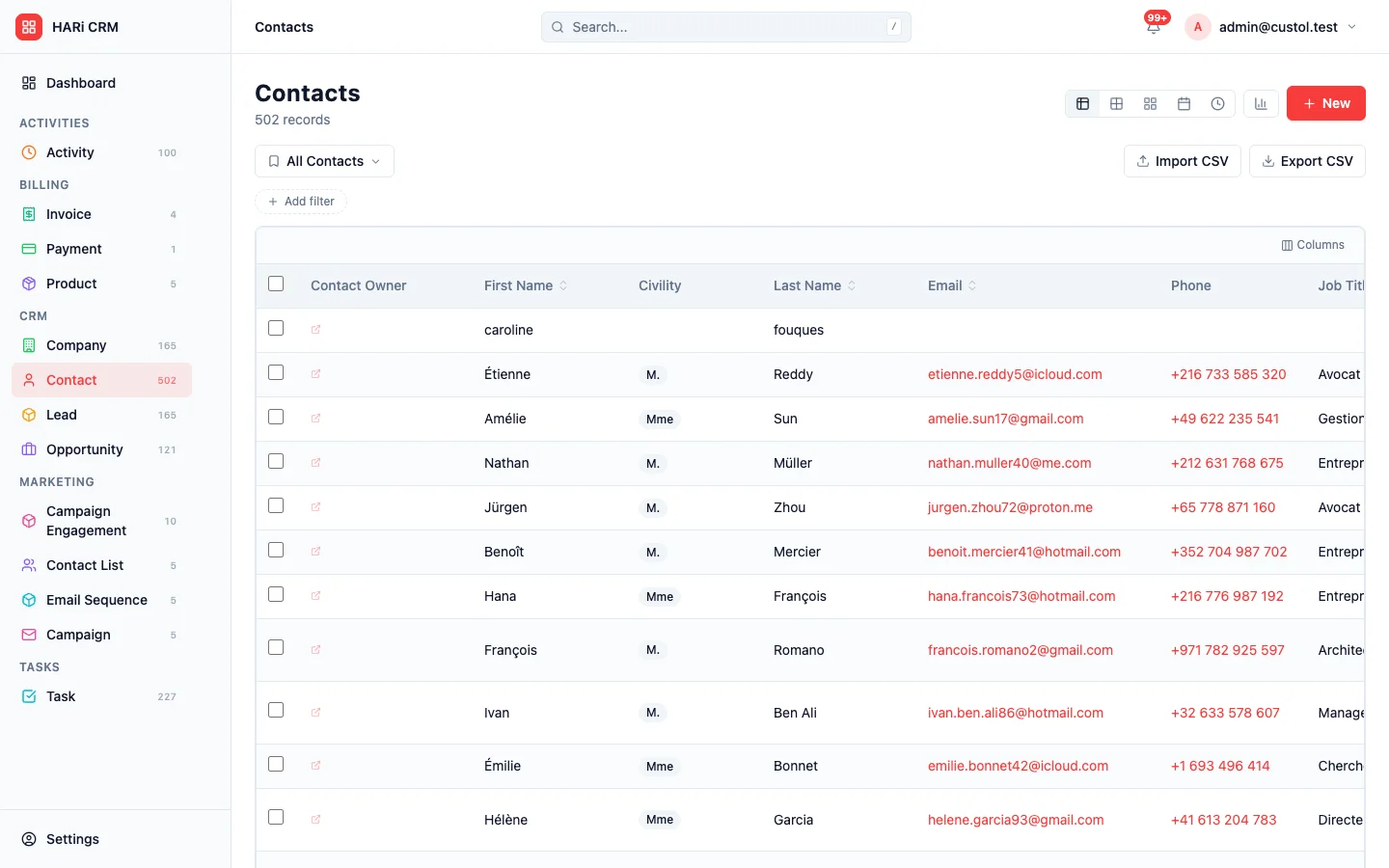
One customer profile that unifies everything you know. Name, delivery addresses (often plural — home, office, mother’s flat in Shatin), order history, preferred language, sizes or preferences, the notes your staff typed in thirty seconds after the last conversation. You don’t need a live Shopify integration on day one to get this — a monthly CSV export of orders, imported against existing customer records, gets you 80% of the value. Add the WhatsApp conversation log on top of that and you have something Shopify alone will never give you.
A short list of things the system should surface without being asked. A regular who hasn’t ordered in 90 days. A customer whose complaint is still open after 7 days. A wholesale enquiry that never got a follow-up. Not a dashboard to check — a handful of prompts that tell your team what the next useful action is. If a CRM is another tab you have to remember to open, it will lose to WhatsApp every time.
Segmentation that matches how you actually run the store. VIP (three or more orders). Wholesale enquiry. Gift buyer. First-time buyer in the last 30 days. Lapsed 6 months. Return or complaint in last 90 days. Five to ten tags cover almost every outreach decision you will ever make. You don’t need 50 segments — you need the right 8.
Notice what isn’t on this list. Pipeline forecasting. Lead scoring algorithms. Sales commission tracking. Those are solutions to problems a 4-person online store does not have. When you evaluate tools, cut straight past that layer and look at the customer record view. If it doesn’t look like a place your team would actually open 20 times a day, it isn’t the right tool.
The multi-channel reality: WhatsApp, IG DM, email, Shopify order notes
Here is a rough breakdown of where a typical Hong Kong online-store customer conversation actually happens.
WhatsApp is the default for most local customers and for the mainland-facing ones using WhatsApp through a VPN. It’s where pre-sale questions go, where post-sale updates happen, where complaints start. Instagram DM is where younger customers message, especially if they came in via an influencer post. Email carries the order confirmations, the shipping notifications, and most of the formal complaint escalations. Shopify’s own order notes sit somewhere in between — useful for internal staff notes, invisible to the customer, easy to forget.
All four channels can touch the same customer in the same week. A buyer sees an IG ad, DMs with a question, gets an email receipt after she orders, WhatsApps to ask where the parcel is three days later, and messages again two weeks on to say the shoes don’t fit. If each of those conversations lives in a separate inbox, nobody serving her has the full picture. The staff member on WhatsApp that morning has no idea she already sent an angry IG DM to your co-founder the previous evening.
A unified inbox — or at minimum a customer record with every conversation pasted or linked into it — is what changes the equation. Your staff opens the record once. They see her complaint from last week, her order from three months ago, her preferred language, and the note that she is a size 37 not 38. They respond in 90 seconds with context, not with “let me check and get back to you.”
HARi CRM today supports email and Telegram in a unified inbox. WhatsApp support is shipping in Q2 2026 — until then, most stores paste the key WhatsApp conversations manually into the customer record, or just add a short note summarising the exchange. It’s not elegant, but even the manual version beats the alternative of pretending the WhatsApp thread doesn’t exist.
Cross-border nuances: customs, shipping, currency, language
If you only sold to Hong Kong buyers, most of this section wouldn’t apply. But most HK online stores don’t — the market is small enough that cross-border is how the numbers work.
A few practical fields your customer record probably needs that a generic CRM won’t include by default.
Shipping destination patterns. Mainland shipments need an ID or passport number for customs clearance. EU shipments need VAT context. Taiwan and Singapore don’t care about either. Your customer profile should capture these once — not force your team to re-ask on every order.
Preferred currency display. You probably price internally in HK$ and display the checkout in USD, EUR, or RMB depending on the customer. The CRM should log the original order currency alongside the HK$ equivalent, so your reporting and your customer conversations line up. Mrs Chan paid HK$1,840; Ms Tanaka paid JPY 35,000 which hit your account as HK$1,790. Both are real orders. Both are the same product. The CRM needs to recognise that.
Preferred language and script. Your team speaks English, Cantonese, and probably some Mandarin. Your customer base speaks all three plus Japanese, maybe Korean, maybe French. The customer record should tag preferred language so that whichever staff member responds, they respond in the right one. Answering a Japanese customer in English when she has been writing to you in Japanese is a small thing that feels large to the person receiving it.
Customs value and HS code history. For cross-border shipments you do often, the paperwork is copy-paste once the first order is done right. A CRM that remembers the last declared value and HS code saves your fulfilment person twenty minutes per order.
Tax status per jurisdiction. Hong Kong has no GST or VAT. Singapore does, Thailand does, the UK does. Your team needs to know whether to include or exclude at quote time for wholesale enquiries. Store it against the customer or the country — don’t make someone look it up every time.
None of this is glamorous. All of it is the difference between a store that scales past 300 orders a month and one that drowns at 150.
Three common scenarios and how a CRM handles them
Scenario A: the returning customer and the new staff member. A regular buyer, Mrs Wong, WhatsApps on a Saturday morning asking whether the rose-gold version of the necklace she bought in October is back in stock. Your new part-time staff member is the one on the phone. Without a CRM, Mrs Wong gets a stranger-grade reply — polite, accurate, but with no warmth. She gets an answer, but she feels like a first-time customer. With a CRM, the staff member pulls her record in 15 seconds, sees the October order was a birthday gift for Mrs Wong’s mother, and opens with “Welcome back Mrs Wong — was the necklace well received last month?” The cost of that second version is zero. The difference in how the customer feels about the shop is substantial.
Scenario B: the complaint that almost got lost. A customer in Melbourne messages at 2am HK time on WhatsApp to say the bracelet clasp broke on day two. Your night shift sees the message, apologises, says someone will be in touch. Monday morning, the morning shift doesn’t see the WhatsApp thread — it’s on a different staff member’s phone. The customer waits three days, then writes a 1-star review. Every small online store has a version of this story. A CRM doesn’t stop the complaint from happening — but it stops the handoff from failing. The Sunday night reply creates a case on the customer record. The Monday team sees it at standup. The resolution gets tracked. The review either never gets written or gets updated once the replacement ships.
Scenario C: the VIP dormant for six months. A customer who bought six times between January and August last year has not placed an order since. In Shopify, she shows up on the “customers who haven’t ordered recently” report if you go looking for it. In a CRM with the right segment, she shows up in a list of 14 VIPs your team is asked to reach out to this week. Your owner or senior staff sends her a personal WhatsApp — not a mass broadcast — with a product recommendation tied to her past purchases. Maybe she responds, maybe she doesn’t. Over 14 customers, three or four usually do. That’s one to four thousand Hong Kong dollars of recovered revenue for ten minutes of thoughtful outreach.
None of those three scenarios requires a clever algorithm. They require the customer record to exist in a shape your team can actually use.
How to actually start without over-engineering
The single biggest reason small online stores stall on CRM adoption is they try to do it perfectly on day one. Don’t.
Don’t migrate five years of Shopify data. You don’t need it. Export the last 12 months of customers and their order totals — that’s roughly 80% of the value of the entire dataset, and it’s something a CSV import can handle in under an hour. The rest can wait or stay in Shopify as an archive.
Add WhatsApp conversations going forward, not retroactively. Trying to reconstruct 18 months of WhatsApp threads is a full-time job. Instead, agree with your team: from today, when we have a meaningful WhatsApp exchange with a customer, we log the gist of it on the customer record. Takes 30 seconds. Two weeks of discipline beats six months of perfect migration.
Pick five tags and start tagging. VIP. Wholesale. First-time (last 30 days). Lapsed (6 months no order). Complaint open. That’s it. You can add more later. Starting with fewer tags that everyone uses consistently is better than starting with fifteen that people forget.
Log the last big customer conversation for your top 50 customers manually. This is a one-afternoon task. Open the top 50 customer records, add a one-line note from memory or from your phone’s WhatsApp search: “Last spoke Feb 14, she was thinking about a gift for her husband’s 50th in April.” That’s it. Those 50 notes will do more for your business in the next 90 days than any feature you haven’t shipped yet.
Revisit after 90 days. By then you’ll know which fields you actually use, which tags are working, and which scenarios from section seven have played out in real life. Adjust. Don’t try to design the perfect schema on day one — you will get it wrong in interesting ways, and that’s fine.
The point is not to have a beautifully structured customer database in six months. The point is to stop losing conversations and customers this week.
What this looks like with HARi CRM
A brief practical note on fit, because it’s a fair question.
HARi CRM was designed for exactly this shape of business — the 3-to-20 person team running multi-channel customer operations without the budget or appetite for Salesforce. It has a flat monthly price for the whole team, so the part-time weekend staff and the owner’s dashboard access don’t each add a seat. It supports CSV import from Shopify (or any other source) on day one, and the fields are customisable so the customs, language, and currency fields described above can be added without code. Email and Telegram are in the unified inbox today; WhatsApp is shipping in Q2 2026. AI search across your records is included — useful when you’re trying to remember which customer asked about the cream version of the bag last quarter.
It’s not the only option, and it’s not the right tool for every business. If you run a 200-seat contact centre, look elsewhere. If you’re a 6-person online store shipping to 14 countries and you’d rather spend your evenings sourcing the next product than wrestling with configuration screens, it might be worth a look.
Have a read of the features page to see what ships today and what’s on the roadmap, or check pricing for the flat-price model. Most small online stores we talk to find out in the first week whether the tool fits — two hours of set-up, one week of use, and you’ll know either way.