Hong Kong handled nearly 4,500 vessel arrivals a month in 2025. Its airport moves more air cargo than any other airport in the world. The logistics and freight forwarding industry is one of the city’s economic backbones — yet most small freight forwarders run their businesses on a combination of WhatsApp, email threads, and spreadsheets that would make a junior accountant nervous.
The business is relationship-driven in a way that most industries are not. Your clients are importers and exporters who ship regularly — sometimes weekly. They need a forwarder they trust to get their goods cleared, documented, and delivered without surprises. That trust takes years to build and can evaporate in one missed customs filing or one shipment that nobody followed up on.
The challenge is not moving freight. Hong Kong forwarders are among the best in Asia at that. The challenge is managing the client side of the business — tracking which clients are active, which need a follow-up, who is shopping around for a cheaper rate, and which new prospect has been waiting three days for a quote.
The freight forwarding business model
Before talking about CRM, it helps to understand how a typical small freight forwarder in Hong Kong operates.
A 6-person freight forwarder in Kwun Tong Industrial Area might handle 40 to 80 shipments a week. Some are sea freight — container loads or LCL consolidations out of Yantian or Kwai Chung. Some are air freight through HKIA. Some are complex multi-modal jobs that start with a truck from a factory in Dongguan, cross the border by road, then fly to Frankfurt.
Each shipment has a client on one end (the exporter or importer), a shipping line or airline on the other, a customs broker somewhere in the middle, and a destination agent handling delivery at the far end. Every one of those relationships matters.
The client relationship is the one that generates repeat business — and the one that gets the least systematic attention.
Most freight forwarders track their shipments well. They use freight management software, or a basic TMS, to log bookings, generate house bills of lading, and handle customs declarations. What they almost never track systematically:
- Which clients haven’t shipped in 60 days
- Which prospects requested a quote but never converted
- Which clients complained about a delay and were promised a credit
- Which existing clients could be moving more volume if someone asked
This is exactly what a CRM is for.
Three freight forwarding teams, three common problems
The 6-person NVOCC in Kwun Tong. Ocean freight, mostly export from the Pearl River Delta to Europe and North America. They have about 80 active shipper accounts. The owner manages the top 20 personally. The remaining 60 accounts are effectively “self-service” — clients book by email or WhatsApp and the operations team handles it, but nobody is proactively managing these relationships.
When a competitor offers one of those 60 accounts a better rate, there is no early warning. The client switches. The forwarder finds out when the bookings stop. Nobody noticed because nobody was watching.
The 8-person air freight agent at Kowloon Bay. Specialised in time-sensitive cargo — electronics components, pharmaceutical samples, e-commerce returns. Their clients are demanding and they pay well. The problem: every client conversation lives in the WhatsApp of whichever sales rep handles that account. When a rep is sick or on annual leave, the client emails the company and gets a delayed, incomplete response from someone who has no context.
The same client had a bad experience last month — a shipment delayed at customs because the commercial invoice had an error. It was resolved, but it was embarrassing. The client mentioned it at booking. The ops team member who answered had no idea it had happened because it was logged nowhere.
The 4-person import agent in Sheung Wan. Smaller operation, focused on European wine and specialty food imports for HK restaurants and retailers. They know their clients personally — most are independent restaurants in the Mid-Levels, Soho, and Wan Chai who order three or four times a year. The problem is seasonal: when Chinese New Year approaches, every client orders at once. The team is overwhelmed. Quotes go out late. Follow-ups slip. A few clients don’t get the attention they need and switch to a larger agent who can respond faster.
What all three teams have in common: the client relationship data lives in people’s heads and personal phones, not in any shared system. The business is at risk every time a sales rep leaves, gets sick, or simply gets busy.
What a CRM does for a freight forwarder
A CRM does not replace your freight management software. You still need a TMS or your own system to handle bookings, bills of lading, and customs documentation. A CRM sits on top of that — it manages the client relationship, not the operational side of the shipment.
Here is what that looks like in practice:
A shared client record. Every client has a profile that the whole team can see: company name, contact people, shipping lanes they use, typical cargo type, payment terms, and a log of every conversation — email, WhatsApp, phone call, meeting. When a client calls and the usual account manager is at the airport, anyone in the office can handle it professionally.
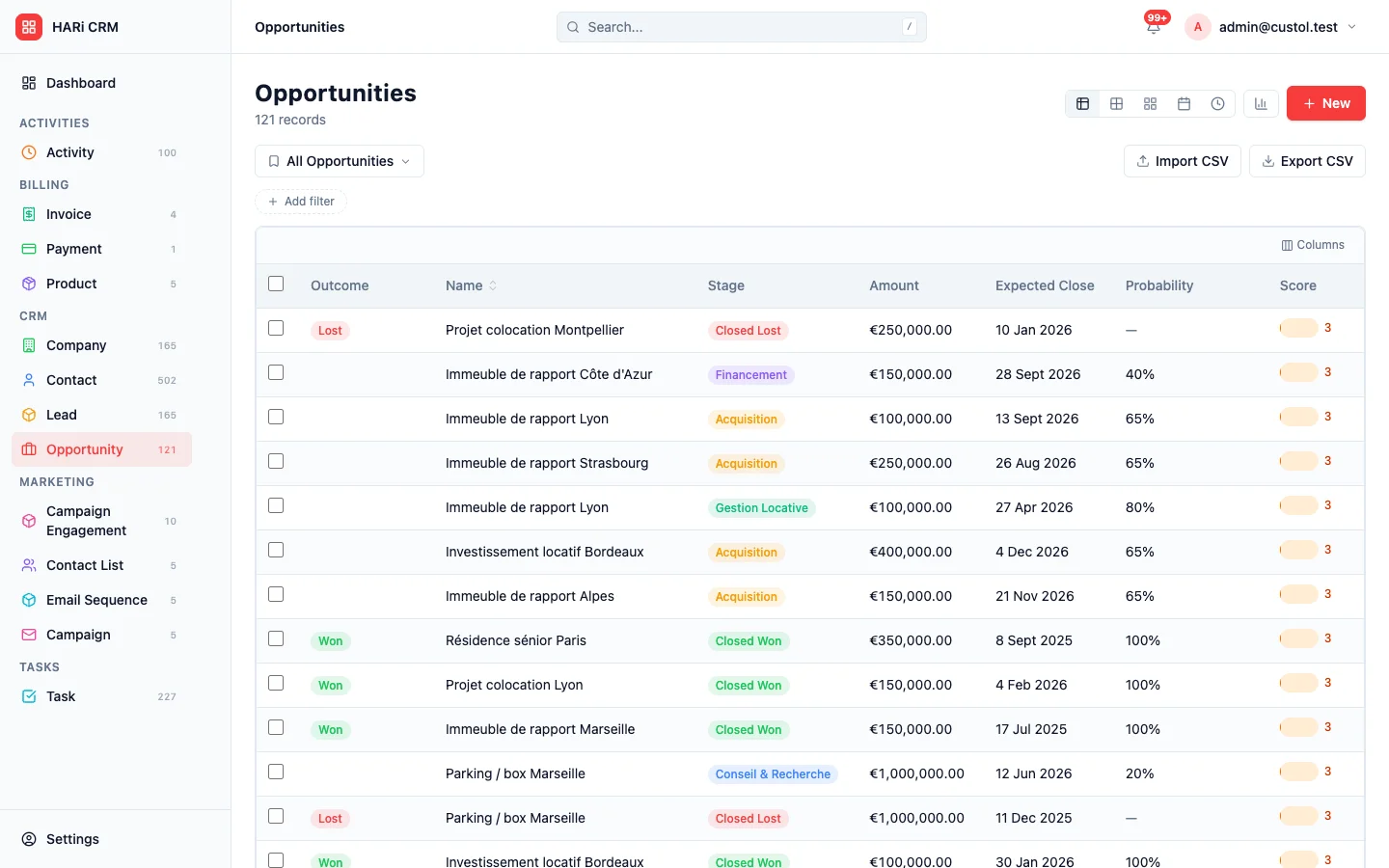
A pipeline for quotes. Every new enquiry is a potential deal. Instead of quotes being tracked in an email folder (or not tracked at all), each quote becomes an entry in your pipeline: the client, the route, the cargo type, the quoted rate, and the stage (Enquiry received → Quote sent → Rate accepted → Booking confirmed → Shipped). You can see at a glance which quotes are pending a response, which have gone cold, and how much new business is in progress.
Follow-up reminders that actually fire. A client requests a spot rate for a shipment from Shenzhen to Rotterdam. You send the quote. A CRM lets you set a follow-up task: “If no response in 48 hours, follow up.” That task appears in your team’s to-do list. Without a system, the follow-up depends on someone remembering. With one, it’s automatic.
Dormant account alerts. A client who shipped monthly for two years has not made a booking in 90 days. You want to know about that. A CRM lets you filter for clients with no activity in the last 60 or 90 days, so you can reach out before they completely move to a competitor.
Client history that protects you. When a client complains about a shipment — damaged goods, a delay at customs, an incorrect invoice — log it. Not to cover yourself legally, but because that context matters for the next interaction. When the same client books again, the account manager should know there was a problem and address it directly: “I know we had an issue with your last air freight shipment. Let me personally make sure this one goes smoothly.” That kind of follow-through turns a complaint into loyalty.
The WhatsApp problem in logistics
WhatsApp is deeply embedded in how Hong Kong logistics businesses operate. Clients send shipping instructions on WhatsApp. Rate confirmations happen on WhatsApp. The trucker says the container is loaded — on WhatsApp. Suppliers confirm the cargo is ready — on WeChat.
The operational use of these channels is fine. The problem arises when the entire client relationship lives on a personal phone.
A sales rep who handles 20 accounts has 20 WhatsApp threads running on their personal device. When they leave — and turnover in logistics is not low — those threads go with them. The client’s contact is gone. The conversation history is gone. The business has to rebuild that relationship from scratch with the next person, often without even knowing what was discussed.
A CRM with proper channel logging means that key conversations — quote requests, complaint resolutions, rate negotiations — get logged to the client record. Not every WhatsApp message, but the ones that matter. This takes 30 seconds per conversation and is worth it.
The goal is not surveillance. The goal is institutional memory. Your business should know your clients, not just your individual staff members.
Pricing that makes sense for a small logistics team
Freight forwarding in Hong Kong is a margin-thin business. You’re competing against global logistics players — Kuehne+Nagel, Panalpina, Kerry Logistics — with a fraction of their overhead. Software costs need to be justifiable.
Most CRM vendors charge per user. At HK$400-1,000 per person per month, a team of 8 pays HK$3,200-8,000 every month for CRM alone. For a forwarder whose net margin on a container shipment might be HK$800-2,000, that is a significant ongoing cost.
Flat-rate pricing changes the calculation. One monthly price for your whole team — operations, sales, management, accounting. Everyone who touches a client relationship can be in the system. No mental gymnastics about which seats to assign, no paying extra when you hire a temp during peak season.
This is how HARi CRM is priced — one flat rate, unlimited users. For a freight forwarding business where operations and sales need to share client data, this model makes far more sense than per-seat.
How a Kowloon Bay forwarder uses this in practice
Let us go through a realistic week at a mid-sized air freight agent.
Monday. The week starts with 12 open quotes across three account managers. All of them are visible in the shared pipeline. Six quotes have been waiting more than 48 hours — the system flags them. Two account managers each have follow-up tasks in their queue before 10am. No chasing, no “did you follow up on that Taipei enquiry?”
Tuesday. A new enquiry comes in from a pharmaceutical company in Sha Tin. They need urgent courier-equivalent air freight for clinical trial samples — Hong Kong to Singapore, twice weekly, indefinitely. This is a high-value recurring account. The managing director creates a deal in the CRM, tags it as “priority”, and assigns it to the most experienced account manager. The client gets a response within the hour.
Wednesday. A client who ships electronics from Shenzhen to Los Angeles calls with a complaint — the last shipment arrived two days late because the customs broker at LAX missed a detail in the documentation. The ops team leader finds the client record, sees a note logged by the account manager three weeks ago flagging a similar issue with this client’s documentation, and calls back with a clear explanation and an offer to review all future shipments before departure. The client is frustrated but feels heard.
Thursday. The managing director runs a report: which clients have not shipped in the last 60 days? The list has 14 names. She assigns five to each account manager as follow-up tasks with a simple note: “Rate enquiry — see if they are actively shipping or have moved to another agent.” Three of the 14 turn out to have new shipment requirements they haven’t mentioned because they assumed the forwarder wouldn’t be competitive. Two new deals are created before the week ends.
Friday afternoon. A client sends a WhatsApp asking whether HARi’s forwarder can handle a new lane — air freight from Hong Kong to Dubai. The account manager logs the conversation in the CRM as an opportunity, checks what other clients ship to Dubai, and sends a note to a partner agent in Dubai to confirm capacity. The client gets a response by end of day. Without a system, that WhatsApp would sit on the account manager’s phone over the weekend, and the client would follow up Monday having assumed no one cared.
Getting started without disrupting operations
The fear with any new system is disruption. Freight forwarding is a real-time business — you cannot have the team offline learning software while shipments are moving.
The practical approach: start with the sales and client management side only. Do not try to connect your CRM to your TMS or customs software in week one. Use the CRM for three things initially:
-
Import your active client list. Company name, key contacts, the shipping lanes they use, and any notes about their preferences or recent issues. This can be done in an afternoon from your existing contact list.
-
Move your live quotes into a pipeline. Any current quote request becomes a deal in the pipeline. Takes 5 minutes per quote. Once it is in the system, any team member can see the status.
-
Set follow-up tasks for your top 20 accounts. These are the relationships that generate most of your revenue. Each one should have a next action logged — a call to check in, a rate update, a note about an upcoming peak season opportunity.
That is a half-day of setup. The value shows up within the first week, when a follow-up happens that would otherwise have been forgotten.
The bottom line for logistics businesses
Hong Kong’s freight forwarding market is crowded. Clients have more options than ever, and switching costs are low — all it takes is a better rate or a faster response from a competitor.
The forwarders who retain clients over years are not necessarily cheaper or faster. They are more reliable, more proactive, and better at maintaining the relationship between shipments. A client who feels known — whose preferences are remembered, whose complaints were resolved, who receives a call before peak season asking what they need — is a client who does not shop around.
A CRM does not make you a better freight forwarder. It makes it possible to apply what you already know about client relationships, systematically and consistently, even as your team grows and your client list expands.
If your operations are solid and your client relationships are running on WhatsApp threads and personal notebooks, that is the gap to close.
Start a free 14-day trial with HARi CRM. Import your client list, set up a quote pipeline, and see what a shared view of your client relationships changes. No credit card required. No consultant needed.
Related reading:
- CRM for Trading Companies: Managing Cross-Border Deals in Hong Kong — similar challenges for Hong Kong trading intermediaries
- How to Move Your Contacts from a Spreadsheet to a CRM — practical guide to importing your existing client data
- The Problem with Per-Seat CRM Pricing — why flat pricing matters for small operations teams