It is 9:15 on a Monday morning and you are Dr. Chan, one of two dentists running a private practice on the fourteenth floor of a medical building off Leighton Road in Causeway Bay. Eleven patients are booked. Three are on the waiting list for any cancellation that opens up. Your recall list — patients overdue for an eighteen-month cleaning or check-up — has ballooned to 240 names. One VHIS claim form is sitting on the desk waiting to be filed. And the receptionist called in sick at 8:30, so the main line is rolling to a voicemail nobody is checking, because you and your partner are both standing chairside.
You are not short of patients or clinical skill. You are short of a way to manage the relationships around the dentistry — the reminders, recalls, follow-ups, referral thank-yous, VHIS paperwork, and waiting-list calls — without the whole system collapsing the moment one person is out. The clinical work is the easy part. The patient relationship management around it is the bottleneck, and almost nobody is tooled up for it.
Why generic CRMs fall short for clinics
The CRM category was built for sales teams. Lead, qualified, proposal, closed won. For a medical or dental practice, that mental model is almost exactly backwards. A private clinic does not need a sales funnel. It needs a system that manages an existing population of patients — a few hundred to a few thousand — across years of recurring visits, recalls, and follow-ups. The goal is not to acquire one more patient this week; it is to make sure every existing patient is contacted at the right moment, no-shows are minimised, recall cycles are respected, and the referring GP or satisfied patient is acknowledged so they do it again.
Be honest about scope: a CRM is not a replacement for practice management software or clinical charting. X-rays, treatment charts, prescriptions, and clinical notes belong in a dedicated clinical system. A CRM gives you the relationship layer — communications, recalls, referral sources, waiting lists, and recovered no-shows.
The four pains of running a small private clinic in Hong Kong
No-shows destroy margin, and the margin is not as big as people think. A Hong Kong private clinic typically charges HK$800 to HK$2,500 per visit. An empty chair on a weekday afternoon is not just the lost fee — it is the receptionist’s salary, the nurse’s salary, and the rent on one of the most expensive commercial property markets in the world. Typical private-practice no-show rates run ten to fifteen percent. For a two-dentist practice doing thirty-five appointments a week, that is HK$15,000 to HK$30,000 of lost revenue every month. The fix: forty-eight-hour and four-hour reminders by SMS or WhatsApp, plus a waiting list that fires automatically when a cancellation comes in. Standard CRM automations — almost no small HK clinic has them.
Recall lists die in spreadsheets. Dental cleanings every six months. Annual physicals, skin checks, eye exams. Post-procedure follow-ups. Each should generate a reminder on time. In practice, most small HK clinics track recalls in a paper diary, an Excel tab nobody opens, or the dentist’s memory. Eighteen months later the practice manager realises 240 patients are overdue and has no idea which are still in Hong Kong and which switched to the clinic next door.
Patient communications live in seven places at once. Paper file in the cabinet, practice management software for appointments, WhatsApp on the receptionist’s phone, email for VHIS claims, a Google Sheet for recalls, sticky notes, voicemail. When a patient asks “did you send my VHIS claim last month?” the answer requires opening three systems. When the receptionist is out sick, the context lives on her phone and nobody can answer anything.
Referral sources are the lifeblood of private practice — and almost completely invisible. Private clinics grow through three channels: GP and specialist referrals, word-of-mouth from satisfied patients, and insurance panels. Almost no small clinic tracks any of it. Ask a clinic manager “which five referrers drove the most revenue last year?” and she cannot tell you — the data was never captured when the new patient walked in.
How a CRM actually changes the daily work
A CRM for a clinic is a patient-relationship register with scheduled actions attached. Used properly, it changes four things.
Automated reminders before every appointment. Forty-eight hours before the visit, a templated SMS or WhatsApp goes out: “Hi Mrs Wong, this is a reminder of your appointment with Dr Chan tomorrow at 3:00pm. Reply YES to confirm or CALL to reschedule.” Four hours before, a shorter reminder. When a patient does not confirm, the receptionist makes ten targeted calls instead of fifty random ones. This alone typically cuts no-show rates roughly in half.
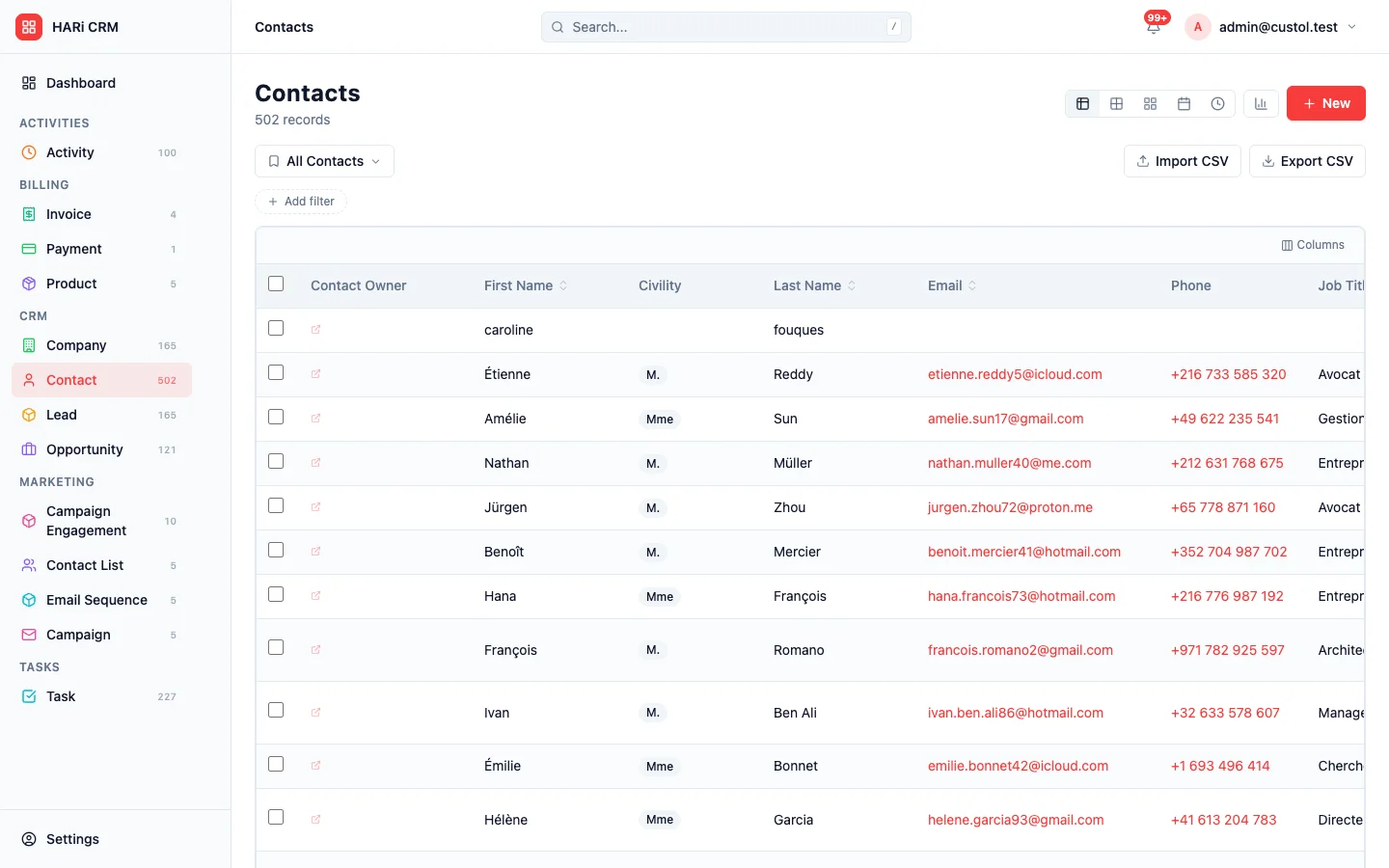
Recall workflows that generate their own tasks. Every patient record holds a recall cadence — six months for a dental cleaning, twelve for an annual physical, three for a post-procedure check. The system generates a task automatically: “Contact Mrs Wong — annual check-up due 2026-05-14.” The recall list becomes a daily work queue instead of a spreadsheet nobody opens.
A patient timeline that survives staff turnover. Every phone call, WhatsApp message, email, VHIS claim, no-show, and rebooking gets logged as a one-line entry on the patient’s record. Not clinical notes — those stay in your clinical system. Relationship notes only: “Patient prefers afternoons, mentioned her husband is also looking for a dentist.” Six months later, when a new receptionist takes over, she opens the record and has the context immediately.
Referral sources captured at the first visit. One required field on intake: “How did you hear about us?” — GP referral (which doctor?), patient referral (who?), insurance panel, Google, walk-in. Twelve months later the clinic manager can see that Dr Lau at a nearby GP clinic sent eleven patients, and three loyal patients have each referred four or more friends. The thank-yous start going to the people who actually drive growth.
Three Hong Kong clinics, three realistic setups
The two-dentist practice off Leighton Road in Causeway Bay. Dr Chan and her partner, one dental nurse, one receptionist. Around 850 active patients. Setup: import the patient list, configure a six-month recall for general cleanings and a three-month recall for periodontal patients, enable forty-eight-hour and four-hour SMS reminders, and add a waiting-list workflow. Within the first month no-shows drop noticeably, and the recall list starts generating thirty to forty re-bookings a month from patients who had quietly lapsed.
The GP in Mong Kok running a family practice. Dr Lee, a single GP with one receptionist, doing around sixty-five visits a week across general consultations, paediatric visits, and EHCVS redemptions. Setup: a record for every regular, tagged with EHCVS eligibility and VHIS status, recall workflows for annual physicals, and a targeted flu-vaccination campaign in September — segmented, not broadcast.
The aesthetic specialist in Central. A single specialist with two nurses, offering laser, injectables, and skin treatments. Setup: patient records with treatment preferences, product sensitivities, referral source, and a post-treatment follow-up that fires three days after every procedure — “How is the treated area feeling? Any concerns? Our nurse Lily can help.” That one message catches clinical issues early and keeps patients engaged instead of disappearing after a single visit.
The Hong Kong regulatory context
A small clinic in Hong Kong operates inside a specific regulatory environment, and any system that holds patient information has to respect it.
Personal Data Privacy Ordinance (PDPO). Medical and dental records are personal data. PDPO’s Data Protection Principle 4 — security of personal data — requires data controllers to take all practicable steps to protect personal data from unauthorised access, processing, or loss. Hong Kong has no HIPAA equivalent; PDPO is the framework. For a clinic this means access controls (not everyone on staff should see everything), secure transmission, and a clear answer to a patient who exercises a data access request under DPP6. A CRM used in a clinic must support role-based access and an audit trail. Clinical records themselves belong in a dedicated clinical system — the CRM holds only the relationship layer.
HKMC, HKDC, and registration ordinances. Medical doctors must be registered with the Hong Kong Medical Council (HKMC) under the Medical Registration Ordinance (Cap. 161) and bound by the HKMC Code of Professional Conduct. Dentists are registered with the Hong Kong Dental Council (HKDC) under the Dentists Registration Ordinance (Cap. 156). Registered Chinese medicine practitioners operate under the Chinese Medicine Ordinance (Cap. 549) and the Chinese Medicine Practitioners Board. Any reminder, recall, or follow-up template should be consistent with the applicable code.
VHIS, EHCVS, and CHP. The Voluntary Health Insurance Scheme (VHIS) and the Elderly Health Care Voucher Scheme (EHCVS) are two of the main ways private clinic fees get paid outside direct self-pay. Tag each patient with VHIS status, provider, and EHCVS eligibility so a quarterly review answers “how many active patients have VHIS with provider X?” in one report. Notifiable infectious diseases must also be reported to the Centre for Health Protection (CHP) under the Prevention and Control of Disease Ordinance — a CRM does not file those notifications, but it helps track internal follow-up.
Why per-seat pricing is the wrong model for a small clinic
A small Hong Kong private clinic has between three and ten people with reason to see the patient system: the doctor, the partner, one or two nurses, a receptionist, a part-time practice manager, maybe a bookkeeper who handles VHIS invoicing once a week.
Per-user CRM pricing in Hong Kong is usually HK$400 to HK$800 per user per month. For a six-person clinic that is HK$2,400 to HK$4,800 every month before the system has prevented a single no-show. Hire a locum for three weeks and you are negotiating licence seats.
HARi CRM is a flat HK$1,990 per month for the whole workspace, regardless of team size. A four-person clinic and a ten-person clinic pay the same. A locum gets access from day one and loses it on their last day, without a licence conversation. Full reasoning: the problem with per-seat CRM pricing.
What to set up in the first week
Do not try to build a perfect system. Four things are enough to make a measurable difference in the first month.
Import the active patient list. Every patient seen in the last eighteen months, with name, phone number, preferred language (English, Cantonese, or Putonghua), last visit date, next recall date, referral source if reconstructable, and VHIS or EHCVS status where relevant. Most practice management systems can export this. The practical guide to moving contacts from a spreadsheet walks through the basics.
Enable appointment reminders. Forty-eight hours before and four hours before. WhatsApp first where you have consent, SMS as a fallback. One template in English, one in Traditional Chinese.
Run your first recall campaign. Pull every patient overdue by ninety days or more. Do not mass-broadcast — send a personal-feeling templated message addressed by name: “Hi Mrs Wong, it has been about eighteen months since your last cleaning with Dr Chan. We have openings this week.” A list of fifty lapsed patients will typically recover five to ten bookings. At HK$800 to HK$1,500 per visit, that is HK$4,000 to HK$15,000 of revenue that was invisible until you looked.
Start logging referral sources on every new patient, today. One required field on the intake form: how did you hear about us? Six months from now you will know which GPs and which loyal patients are driving your growth.
Try it during a slow period
The right time to roll out a new system is whichever month is historically quietest — the weeks straddling Chinese New Year, or late summer when the expat patient base is away. Import the patient list, set up reminders and recalls, train the team over two lunchtimes. By the time the practice is back to full capacity, the system is already running.
Hong Kong private clinics grow on trust and on referrals. The clinics that stand out are the ones where patients feel remembered, reminders arrive on time, follow-ups happen without being asked for, and the receptionist remembers your name on the second visit. A CRM does not create that quality of care — your team does. It gives you the infrastructure to deliver it consistently, even on the Monday mornings when the receptionist is out sick and the phone is ringing.
HARi CRM offers a 30-day free trial — no credit card required.
Related reading:
- CRM for Professional Services Firms in Hong Kong — broader view of how small HK professional firms use a CRM to manage client relationships
- CRM for Accounting Firms and Bookkeepers in Hong Kong — a similar small-practice persona, same pain points, different regulatory world
- The Problem with Per-Seat CRM Pricing — why flat-rate pricing makes more sense for clinics with nurses, receptionists, and locums
- How to Move Your Contacts from a Spreadsheet to a CRM — practical guide to getting your existing patient list into a system